

For everything in the pond, including decomposition processes, oxygen is used. A satisfactory level for ponds ranges around 5 parts per million (ppm). At 1 ppm, many species can die, with the exception of adapted to breathing air in standing and overgrown with plants water.
Augustius (1979) notes the presence of species such as snakeheads (Ophiocephalus), Singhi (Heteropneustes), catfish Clarias, Mahi (Notopterus) from India, have sacs, labyrinthine organs or special chambers near the gills from which they can produce oxygen by breathing air. Another fish dies under anaerobic conditions.
Pullin and Shehadeh (1982) dealt a lot with issues of aquaculture in warm water or, otherwise, the occupancy rate of fish in oxygen-free waters. They describe the experience of using special rice beds (paddy), allowing you to create special communities of some species.
Shelters for fish are made either in the form of a pad, which is located on the periphery in the form of a channel, or in the form of a sump containing fish between periods of flooding of the territory for planting crops (Fig. 13.5 and 13.6).
The temperature of the rice pond reaches 34 ° C with an optimum level of fish growth of 22–28 ° C. In Indonesia, the fish reaches the desired size in 10-12 weeks, while in the colder regions, as in Japan, it may take 2-3 summer seasons before the growth of fish suitable for the pan.
Grassy pads are partially cleared (Tailani, Malaysia) by such herbs as Trichogaster pectoralis, Clarias macrocephalus and predators Ophiocephalus striatus. In this combination, the additional catch of fish reaches 70–400 kg / ha per year (water temperature 10–34 ° C).
In general, water bodies (flood lagoons) are classified as follows:
- Aerobic: where oxygen is abundant due to the action of winds, swirling flows, rapids and where a small amount of decaying organic matter is present.
- Non-systemic: swamps and overgrown mud ponds, ponds for secondary wastewater treatment, ponds where aeration is present, but sedimentary deposits accumulate in cold periods, after which the bottom of the pond becomes anaerobic.
- Anaerobic: water bodies for primary waste treatment, as well as overly fertilized shallows, where oxygen is low (1 ppm or less).
How much less oxygen is dissolved in warm water compared to cold, and how much less plants produce oxygen during the day than they consume it at night, the likelihood of oxygen deficiency in summer nights in shallow, overgrown ponds is equally likely. If such a pond contains commercial fish, attention should be paid to reducing waste and organizing automatic aeration systems.
These problems are less in open, flowing and cold reservoirs. But when the level of fish population in the pond exceeds 5000 kg / ha, the problem of oxygen supply appears, which is solved, in particular, by the saturation of water with air bubbles:

The simplest cone aerator drives oxygenated water in a closed part of the pond. This reduces fish loss due to deoxygenation and also helps to remove trout eggs in gravel.
There are a number of commercial aerators on the market, many of which can be powered by solar panels. Remarkably, if it is possible to direct the flow of water from a height of 2 m or more, use a variety of fountains, “flow forms” (Fig. 4.34). They will perfectly saturate the pond with oxygen.

Such forms have been used since ancient times. They are easy to make from clay or fiberglass for aeration of water in the presence of a constant water flow.
Significant energy savings are achieved if the pond is aerated in only one of its parts. At the same time, fish will be collected there at the time of need. For eels, such a saturated part of the pond is connected by a narrow channel to the rest of the pond, so oxygen-saturated water will be kept in one place.
Ideally place fish feeders near aeration zones. This makes it easier to oxidize the waste and control its location in the pond. Figure 13.8 illustrates these ideas.
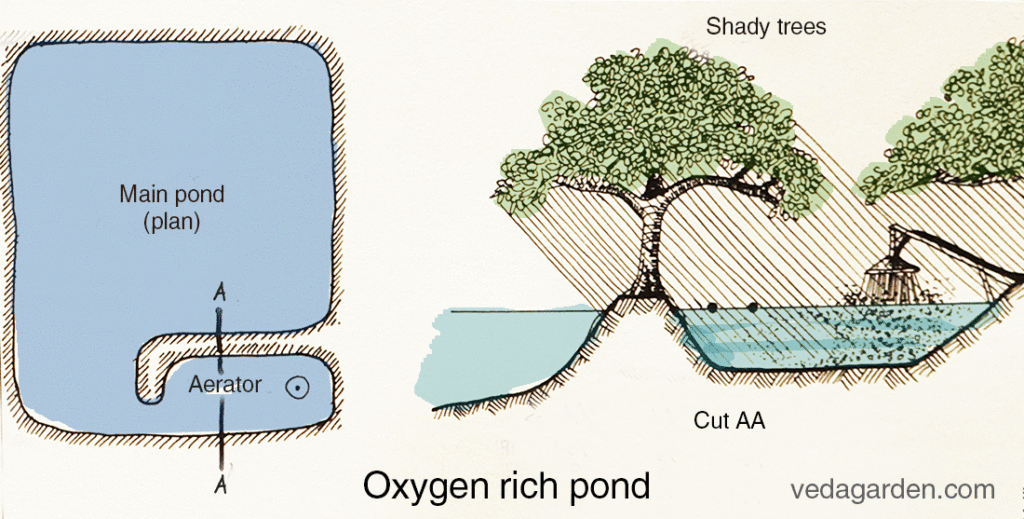
The limitation of a part of the pond allows oxygen to be retained during a critical period. Here you can feed the fish. Shade helps retain oxygen.